

It still happens. I’m out and about and here comes someone in a WFMU T-shirt (mom, child on her hip, supermarket) or I spot a car with an ‘FMU bumper sticker (Subaru, green, town pool parking lot) or a social media “friend” gushes about the station or I’m visiting friends and they have the station on… and I confront several realities at once:
40 years ago – July 4, 1986 – I did my first appearance on WFMU.
10 years ago – July 5, 2016 – I did my last appearance on WFMU.
WFMU was once the center of my world.
WFMU no longer is.
For those who don’t know what WFMU is, a quick primer:
WFMU is a 1440 watt FM station broadcasting from a radio tower in West Orange, NJ.
It went on the air in 1958, licensed to the now-defunct Upsala (hence the “U” in WFMU) College of East Orange, NJ.
In the last half of the 1960s the programming went “freeform”as DJs began to play whatever interested them.
The station gained a reputation for being on the musical cutting edge and punching way above its weight as a taste-maker.
As the ‘60s became the ‘70s the station began raising funds by appealing directly to listeners on air in multi-day events that eventually became the “Marathon.”
In the 1980s, as Upsala College entered its decline, ‘FMU became more independent and musically influential, gaining national press.
In the ‘90s, before Upsala’s demise, the broadcast license was transferred to a not-for-profit corporation. Streaming of the station’s signal began.
In the next decade, WFMU moved out of East Orange to its own building in Jersey City, diversifying its online presence by adding several alternate streams.
WFMU continues to be one of the few totally independent FM stations in the world.
I’m compiling this from memory, so no points if I got anything wrong. The broad outlines are correct and others have written better histories of the station. This is about the two WFMU anniversaries I just experienced.
It’s hard to believe I first stepped in front of a WFMU microphone (no doubt a Shure SM58) forty years ago and last did so ten years ago.
Friday, July 4, 1986: Tom, Jim and I drive out from Hoboken to Froeburg Hall on the Upsala campus to hang out with Kaz, doing his afternoon shift. Just outside the back door to the WFMU offices and studios we set up a charcoal grill and put a mic on it, running several 25’ long microphone cables back to the console so we can capture the sizzle of our Foodtown hot dogs and hamburgers. I’d met Kaz at a Hoboken house party a few weeks prior as he went around the apartment recording WFMU station IDs straight into the tiny mic of a Panasonic “lunchbox” cassette recorder. He’d written some short scripts and the party guests were cast in various roles. I rose to the challenge, punching up the writing, crafting new scenarios on the fly, doing voices, making with the funny. Kaz liked my sense of humor and after the July 4th show (during which we mocked the Statue of Liberty 100th year rededication) and a WFMU schedule change I found myself co-hosting what we dubbed The Nightmare Lounge.
Once a week I’d drive down from Tenafly, pick Kaz up in Hoboken and drive us both out to East Orange. As long as we didn’t run afoul of the FCC, we could do whatever we wanted. And we did, from an incendiary interview with art provocateur Joe Coleman to a live in-studio performance by legendary NYC industrial band Missing Foundation (which I was in at the time) to embodying traveling female DJ characters named after a liqueur (the Kiaffa sisters) to risqué badinage with frequent phone-in callers. We stretched our freedom until it almost broke.
What I didn’t know when Kaz and I began The Nightmare Lounge was that he’d brought me in through a “co-host side door.” A long-time WFMU DJ (he’s still there) once stopped Kaz in the record library and sneered, “That guy will NEVER have a show here.” After me, the station’s by-laws were changed to eliminate the co-host side door and within two years Kaz moved on to greener pastures. I began toiling on the overnight to prove that long-time DJ wrong, doing grueling 3 AM to 7 AM graveyard shifts. When I wasn’t on the air I’d spend endless hours in the fetid Froeburg Hall basement, helping wherever I could. If I wasn’t at work or sleeping I was at WFMU. I even got hired to work in the cramped office alongside the Music Director and Station Manager.
My talk show career began one afternoon in 1989 when someone couldn’t make it for their Noon-time show. I was in the office and volunteered to do the slot. Inspired by the just-released film “Talk Radio” and remembering that my favorite Nightmare Lounge moments were the phone-in portions, I decided I’d do a talk show. I’d also realized I had no business playing DJ on a station teeming with serious record collectors and music mavens. Doing a talk show would also free me from the hours upon hours spent auditioning new music, pulling records out of of the library and putting them back again. Jesus. So Aerial View was hatched, soon becoming WFMU’s first regularly-scheduled phone-in talk show and eventually birthing an entire block of one-hour shows between 6 and 8 pm weekdays. I blossomed as a a talk show host, engaging my bleak outlook and gallows humor to be as acerbic, caustic and irreverent as I wanted. I worked without a call screener, preferring to rely on our broadcast delay to dump anyone with a potty mouth.
In the early ‘90s I was again hired by the station, as Operations/Catalog Director. The first job title meant I was on 24-hour call to drive to the station and transmitter site if anything went wrong. And it did, often. The second job title had me in charge of WFMU’s doomed foray into mail-order, before the internet was a thing (famously, Kurt Cobain can be seen holding a copy of the WFMU Catalog of Curiosities during the MTV Unplugged shoot).
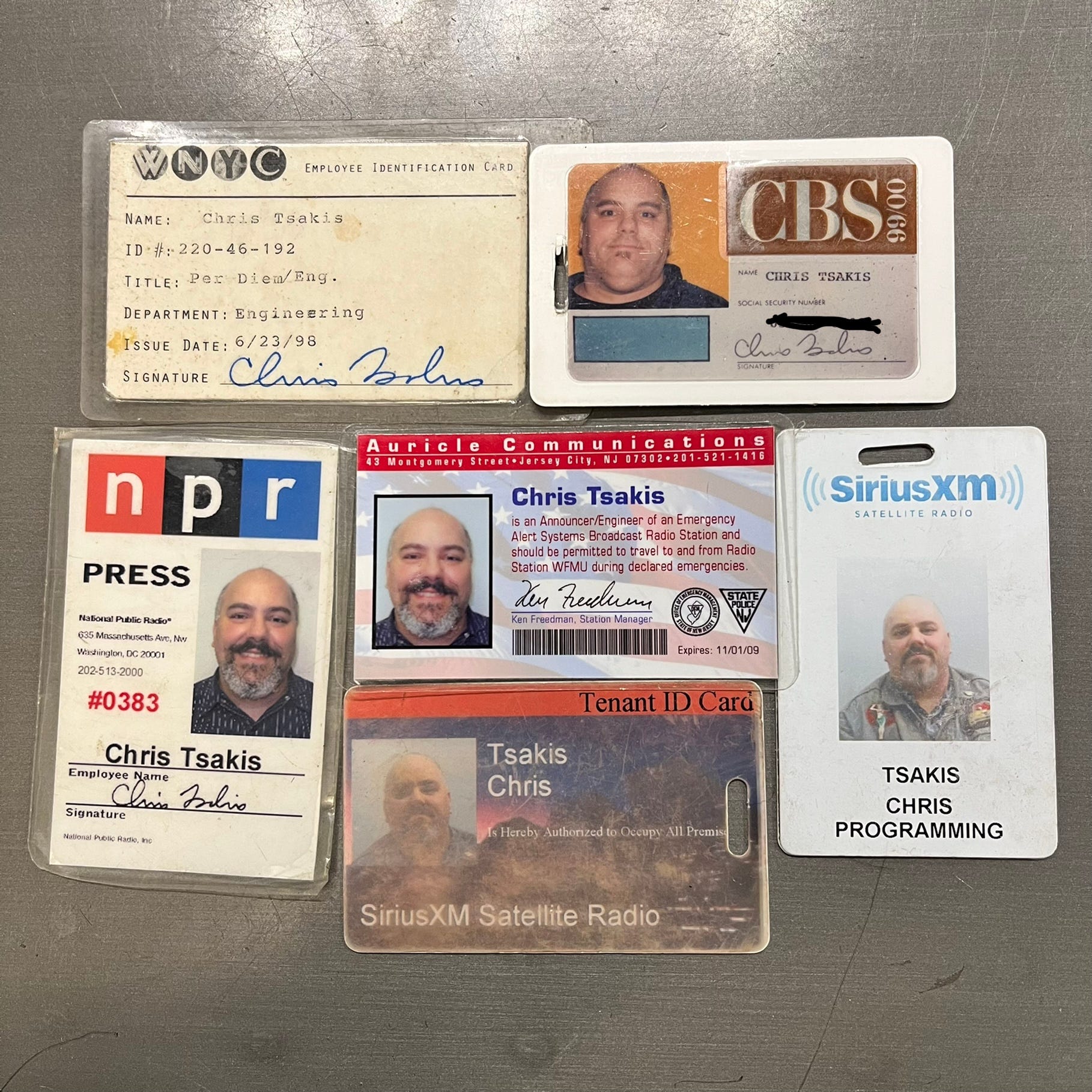
In the late 1990s I began working professionally in radio as a freelance engineer at NPR’s New York Bureau. Simultaneously, I worked part-time in WNYC’s Master Control. I also did a stint engineering the news live from ancient Ampex reel-to-reel machines (one of which is in my basement) at CBS Radio after they bought the Mutual Radio Network. Perhaps the worst radio gig I held was as supposed Operations Director at a Mom & Pop AM “American Song Book” station in Teaneck, NJ where all I did was answer phones and design brochures. I stayed on the roster at NPR the entire time, eventually becoming a salaried part-timer.
In 2002 I was hired by fellow WFMU staffer Michael Anderson (“The Good Doctor”) to freelance on the Blues Channel at the fledgling Sirius Satellite Radio. Around the same time, NPR made me a full-timer. Three years later I met my wife through WFMU while attending a Weird NJ Halloween Party hosted by Glen Jones and X-Ray Burns (RIP). The same year, another WFMU connection – the late Jeremy Tepper - asked if I’d like to co-host a daily talk show on the trucking channel. I’d just gotten into the union at NPR and agonized for a week about leaving the security of a behind-the-scenes union engineering gig to take an on-mic position that might last months. Jeremy inspired me to take a leap of faith, saying “You really should be in front of the mic.” Our new show Freewheelin’ went on the satellite in March of 2005 and for the next twelve years, three hours a day, we talked to truck drivers and interviewed a ton of actors, athletes, authors, celebrities, musicians, etc. They’d exit Howard Stern’s studios, walk down the hall and sit with us. I’m still astounded by all the boldface names I interviewed, from Robert Duvall to Carol Burnett to Tom Jones to Jeff Bridges to Charley Pride to Rosie O’Donnell and on and on.
I’d come a long way from July 4, 1986. Under “Occupation” on my tax return it now read “Talk Show Host.”
Soon, I’d take a hiatus from Aerial View, finding it hard to be on the air at SiriusXM and ‘FMU. I stayed involved with WFMU - cranking out a weekly podcast-only show called “Communication Breakdown” (which eventually ended up airing live on an alternate stream in the mornings). When I resumed Aerial View five years later it was so I could have something of my own (I didn’t know my trucking show co-host would turn out to be an exhausting Dark Triad personality). But after a few years I could no longer rationalize keeping Aerial View alive if it meant dealing with the Station Manager, who I felt no longer deserved my toil after he unloaded on me following a disagreement we had. I agonized over my decision to go but when I emailed him to say I’d be ending things and why, he never responded.
No answer is still an answer, right?
Saying goodbye to WFMU reminded me of leaving The Nihilistics. In both cases the soundtrack in my head was Respect Yourself by The Staples Singers. It’s never been easy to do and it sucks that it seems I’m the only one who gets to live with the consequences.
The world, such as it is, goes on without you.
I’ll always be grateful to WFMU for launching me into what turned out to be a long radio career and for bringing me together with my wife. In the years since I walked through what turned out to be a one-way door I’ve missed ‘FMU terribly. The community. The creativity. The freedom. I still have WFMU dreams. For awhile, I even thought there might be a return. I reached out to the Station Manager via email, text, voicemail and in person, hoping to open a dialogue.
I never heard back.
No answer, etc.
After ten years it’s finally adieu and not au revoir.
I’m trying to get to a place where I can smile and have good thoughts if I see a WFMU T-shirt or bumper sticker or inadvertently hear the station. It’s hard.
It may take another ten years.