

Gaslight? Fight!
I have rights. Right?
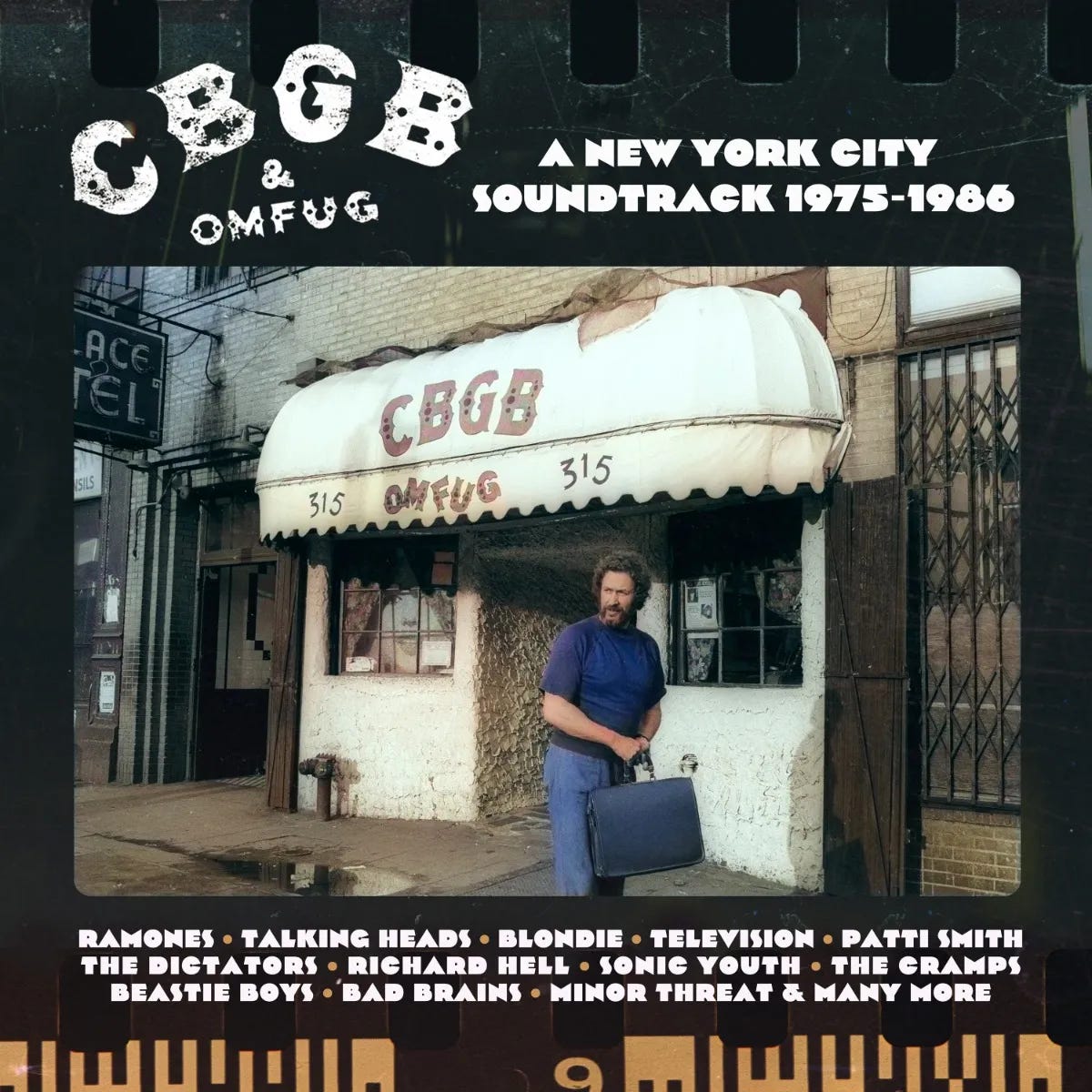
It’s happened again: I heard about another compilation out featuring another Nihilistics song. Last time it was “Black Sheep” on a KBD (Killed By Death) comp by a small label. This time it’s “You’re To Blame” on the Cherry Red 4-CD box set “CBGB & OMFUG: A New York City Soundtrack 1975 – 1986” (above). Cherry Red is a well-established archival and reissue label out of England and the box set came out at the end of January (the 1st pressing sold out: they’re taking orders for a 2nd pressing). When I learned about the KBD comp I sent the label what’s known as a demand letter, which a lawyer friend helped me draft pro bono. A demand letter is just that: it asks the label to show figures for how many units were sold and asserts rights of mine to royalties based on my part in composition and performance of the songs.
I’d share the response I got but I don’t want to see you weep.
Essentially, I was accused of being a Trumpist because “everyone knows” there’s “no money in punk rock.” This is the same shit I’ve heard for years, from the band and anyone who released our material. I’d get small checks here and there, then those went away. When five Nihilistics songs were used in a film a few years ago I heard from Ron and he sent a check. There’s been acknowledgement that I had a hand in creating the music and am deserving of compensation legally. But it’s been sporadic and mostly after the fact.
Like many poor schmucks in bands, how could I know back in 1985 when I left the Nihilistics that decades later the band would still (ostensibly) be performing and that its music would be appearing on compilations and streaming online? When another schmuck in another hardcore band from back in the day alerted me to the CBGB box set I reached out to Ron, the singer, and asked what’s up and whether or not I need to contact Cherry Red directly. Ron and I… how do I describe our relationship? It’s equal parts collegial and adversarial. He usually begins by reminding me how he bought the “rights” to “everything” long ago and doesn’t need to tell anyone about anything. Then he mentions how much he’s spent on the band since he became sole owner, implying that any proceeds from rereleases, compilations, streaming, etc., is minuscule compared to his expenses. He ends by offering me some small consolation. This time it was roughly $23 USD and a free CBGB box set.
Leaving aside that Ron may be misinformed on a few points, my original sin occurred back in the day (1982/1983) when the four band members signed a contract with Braineater Records to put out our first LP (the EP which proceeded it was self-released). According to Ron (who starts many sentences with Don’t you remember…) we signed away our rights (again) to everything (again). Like many young bands eager to put out an album we were too young and naive to know how to protect our rights. When I left the band I didn’t keep track of what they were up to and certainly wasn’t contacted when the intellectual property or anything else (master tapes, etc.) came up for sale. I was never offered a choice to participate.
It’s a tale as old as time, to borrow a Disneyism.
So I did something you may hate: I plugged all the above info into ChatGPT. Here, with some edits by me, is what it gave back:
The key issue is not who says they bought the rights — it’s what documents actually exist. A few principles matter here:
1. Copyright transfers must be written.
Under 17 U.S.C. §204, any transfer of copyright ownership must be in a written instrument signed by the owner. Oral agreements or “understandings” don’t count. If I never signed a written assignment transferring my share of the copyright in the sound recordings or compositions, my ownership likely never disappeared.
2. A band member cannot sell other members’ copyrights.
If Ron later “bought back” rights from Braineater Records, that purchase would only transfer whatever rights Braineater actually owned. If Braineater’s contract only granted them rights in the master recording, then buying it back would not automatically give Ron the publishing or co-author shares of the other band members.
3. Self-released recordings complicate the story.
The EP that predated the LP was self-released by the band. Then the starting assumption is usually:
the band members jointly owned the master recording, and
the songwriters owned the compositions.
Unless that EP contract transferred those rights to Braineater or later to the singer, those interests often remain split among the contributors.
4. Composition rights and recording rights are separate.
Two different copyrights exist:
• the composition (the song itself)
• the sound recording (the recorded performance)
If the songs were written collaboratively, every writer typically retains a share of the publishing unless they signed it away. Even if someone controls the master recordings, they still must account to the songwriters for mechanical royalties and publishing income.
5. The “I spent more than the band made” argument.
Legally, that argument usually goes nowhere.
In copyright law, a co-owner who exploits the work must account to the other owners for profits, regardless of how much money they personally spent promoting the band. Personal expenditures don’t automatically cancel another co-owner’s share unless there was a written agreement saying so. In other words: someone can spend $50,000 on a band and still owe the other copyright holders their share of revenue. Courts have been very consistent about that.
6. Streaming changed the scale of the accounting.
Today the Nihilistics catalog could be generating money from:
Spotify / Apple Music streams
YouTube Content ID
Bandcamp downloads
vinyl reissues
compilation licensing
film/TV sync licenses
publishing royalties via PROs (ASCAP/BMI/SESAC)
mechanical royalties via The MLC
Small bands are often surprised how many revenue channels exist once music is digitally distributed.
7. Sporadic payments can actually strengthen your claim.
When the singer sends money “now and then,” that can be interpreted as acknowledgment that you have an ownership interest. Courts sometimes treat those payments as evidence of an implied co-ownership relationship. It doesn’t settle the exact percentages, but it undermines the claim that he owns everything outright.
Now, stepping back from the legal mechanics, your situation looks like a classic chain-of-title problem. To know who really owns what, someone would have to reconstruct:
the Visionary EP agreement
the Braineater LP contract (1982/83)
any assignment from Braineater to the singer
any publishing agreements
the licenses given to modern labels or streaming distributors
Many punk bands never had a clean chain of title. Reissue labels often rely on whoever appears to control the catalog. What you’re describing is a classic collision between copyright, band politics, and personal narrative. The legal lines between those things are actually fairly clear, even though the human relationships rarely are.
I’m back. First, I apologize for the AI midstream interruption. And remind you, as ChatGPT does, it can get things wrong. But this sounds right to me. Yes, I’m no legal scholar, as evidenced by the fact there’s yet another Nihilistics track on another compilation and I’ll see nothing (Ron again asked for my address, as he does every time this happens, claiming he’ll put a check and a box set in the mail). And I didn’t feel like contacting my lawyer friend with this bullshit again. He has more than enough to do, even though he’s been generous with his counsel.
All of this is why I want to set the record straight with a memoir. Maybe Ron is right and there is no money in this here deal, to quote an old song. But, as I said to him during one of our recent calls, You may own the rights to everything but you don’t own the rights to my story. Ron has controlled the Nihilistics narrative so long because I stepped away from the band after it all went south. My feelings about it are complicated. I owe him a debt of gratitude for keeping the band alive and out there all this time. And I appreciate his role as the older, more stable member back when we were dealing with record labels, promoters, managers, etc. I wanted little to no part of that shit. But the money is far less important to me than the legacy.
It’s begun to creep in that somehow I’m not welcome to my version of events. Troy, the drummer, basically denied that I started and named the band. WTAF? Ron, last time we spoke, went down the same path, telling me that he and Troy remember dates, places, etc. and if I write anything defamatory or factually untrue in any book there may be repercussions. Jesus. All I’ve ever wanted to do is tell the story of me and Mike, the guy who went from being my morbidly-obese sweet-natured best friend I met in Junior High to someone who tried to murder me one night decades later. Why anyone is threatened by that story – especially when it’s NOT a book about the Nihilistics – is beyond me. But when Ron told me that Mike’s wife – the only other person there the night Mike clamped his huge mitts around my throat and choked me until I couldn’t breathe and was about to pass out and the one who screamed, ran over and pulled Mike off me – claims “It never happened” I begin to feel I’m losing my mind.
It’s time to fight the gaslight.
Right?