We live in an age of cognitive dissonance. This morning over coffee, vanilla yogurt with blueberries, and sourdough toast with fake butter, I watched the New York Times video analysis of the Alex Pretti murder. Sweet T., catching up on the news on her phone, interrupted her breakfast to nod along with my commentary.
“You don’t read the Times anymore. You watch it, I guess.”
This is America now. We prop our phones up and watch over breakfast as bullies employed by our government summarily execute the residents of a major city for simply exercising rights guaranteed to every American by the Constitution.
Some thoughts:
We’re not fully a dictatorship yet. Yes, fascists have largely taken over the Executive Branch. But the courts are still ruling against the administration, and while some decisions are being openly defied (looking at you, Epstein files), others are not.
The mainstream—or legacy, or whatever you want to call it—media is not entirely beholden to Dear Leader.
This well-documented murder is not going over well. More and more Republicans are seeing it as untenable.
There will always be a hard MAGA core, but the outer layers are peeling away. Even craven politicians can read the handwriting on the wall.
When the dust clears, we must revamp the Electoral College (and the Supreme Court), but we also need to enshrine every norm as law.
I fucking hate bullies.
Let’s spend some time with point #6.
Some of the most emotional writing I’ve done for NIHILISTIC (the book) concerns the tortured relationship between my “built-in bully”—my brother Marc—and me. I have… had… two brothers, but Mario (who died fourteen years ago of opioid abuse) and I were buffered a few years by my late sister Joanie and then by Marc. Mario and I were also physically separated. By the time he was a teenager, he had his own room, while Marc and I still shared one and were almost constantly in each other’s shit. Mario could turn nasty instantaneously and preferred “fat fuck” to my name, but he had less interest in the daily, grinding torment Marc employed.
Marc never seemed to like me much, perhaps because he felt I supplanted him, arriving not long after he did. My status as “the baby” sheltered me only so long, then was weaponized against me. If I got upset over teasing or some other cruelty and began crying, I’d hear I’ll give you something to cry about, you baby. If I went to my mother to intervene, she’d yell at my brothers, who would respond with some variation of Just wait until she’s not around, you BABY.
It was lonely in my sibling trick bag.
Around eleven or twelve, Marc began weight-lifting and body-building while I continued packing on the pounds. I was medicating my anxiety, insecurity, lack of confidence, self-loathing, and depression with food, while Marc was mixing protein shakes and working out in our paneled basement with his friend Jimmy. They’d be down there grunting and spotting each other for hours, surrounded by taped-up pages torn from one of Joe Weider’s muscle magazines. Weider—who lived to 104—took up body-building as a teenager to ward off bullies. Was that Marc’s motivation? Probably. I always suspected someone was preying on him, but maybe it was just Mario. Maybe Mario was Marc’s bully, so Marc became mine.
As my mother used to say, “Shit rolls downhill.”
There I was, at the bottom of the hill, no need to leave the house to be verbally and physically abused, disgusted by my appearance every time I went downstairs and passed Marc’s workout mirror on my way to the TV. Because I grew up learning that violence was the only solution to interpersonal conflict, I eventually met Marc’s threats with my own. Either I had entered my punk-rock I don’t give a shit! phase, or the confidence I gained acting in school productions and taking up guitar carried the day—or both. We didn’t know from de-escalation, and one of our last fights ended with me menacing him with a butcher knife in our kitchen.
“Come on! Come on, ASSHOLE! One of us is going to the hospital in an ambulance, MOTHERFUCKER!”
Marc smirked at me, said, “Look at you, you fuckin’ PSYCHO,” and headed out the door.
I’ve been thinking about my brother down there in North Carolina, in a town known as “The Heart of NASCAR Country,” for a few reasons. For the first time in years, he didn’t text me on my birthday or at Christmas. I think he’s still pissed about the writing I’ve done about our family. Our last phone call ended with him yelling, “I’ll fucking SUE you if you write anything else about mommy!” before hanging up on me—which was progress, considering he used to tell me he was going to punch me in my “FAT fucking FACE.” Marc will really hate this if he ever reads it, but I’m not writing out of spite. The older I get, the more clearly I see the tragedy in our estrangement.
I had big brothers, but neither seemed remotely interested in being a big brother. I was a pain in the ass, merely competition for resources, affection, attention. If they ever felt protective or brotherly toward me, I never sensed it. Maybe this is common in families. I don’t know. Maybe people mature and eventually lay aside resentments and animus toward their siblings. Maybe not. Maybe the estrangement just goes on and on until all involved say Fuck him. I’m not quite there yet. I have this perverse desire to have one last go-for-broke conversation with Marc, where I finally get to ask the questions I’ve been saving up:
Why did you hate me so much?
Did you ever feel affection for me?
What was going on with you back then?
Was there a reason you started working out?
Was someone bullying you or preying on you?
Do you ever miss me, or feel sadness over all we lost?
Loss is one reason I’ve been thinking about my brother. The rise of American fascism is the other. Over another recent meal, while reading about Minneapolis, I said to Sweet T., “I wonder if my brother joined ICE.” She scoffed, but I pointed out, “He is MAGA. And they were offering a fifty-thousand-dollar signing bonus. And all kinds of perks…”
She still didn’t see it.
“How would we even know?” I said. “I don’t know if he’s dead or alive. I’m not even sure my sister would call if he was dead.”
Yes, the estrangement extends to my sister as well. If my relationship with Marc is comatose, the one with my sister is on life support. Today I texted her a picture I’d stumbled across, one of many stereo slides shot by our Aunt Isabel, an amateur photographer. The Kodachrome she used held up remarkably well, and even shooting through the lens of her old stereo viewer with my phone couldn’t diminish the photo’s immediacy:
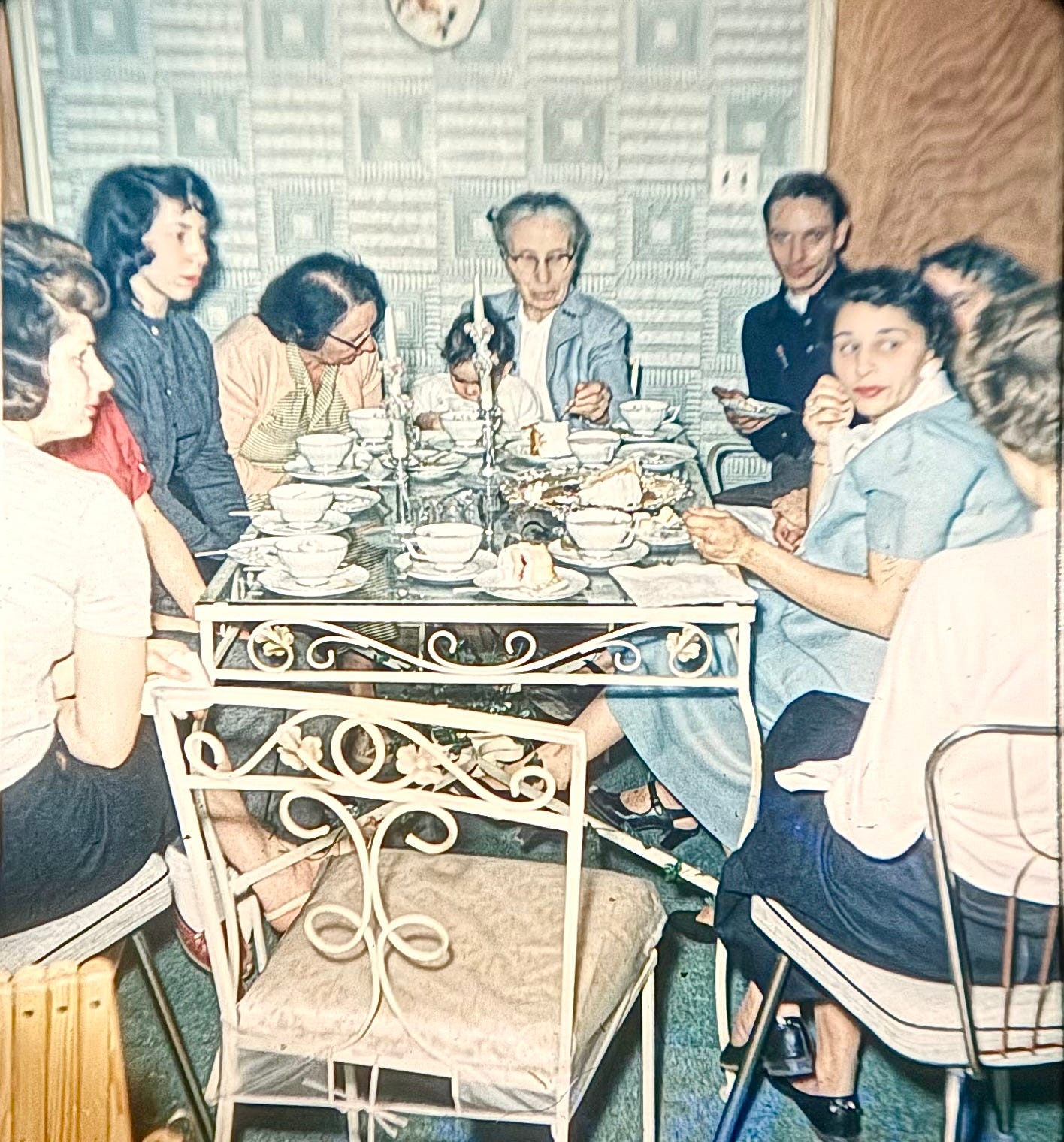
In the scene, eight women and my Uncle Donny are gathered around a white wrought-iron, glass-topped table, eating cake and drinking coffee. I recognized my paternal grandmother Henrietta at the back of the table and guessed it was my sister Diana on her knee. My mother, on the right side, faces the camera, though her attention is fixed on a woman with her back to us. Between Donny and my mother sits my grandmother Evelyn, AKA Nana. In profile on the left side of the table is my recently deceased Aunt Marie Louise, the last surviving member of my father’s family, who made it to ninety-three. The woman leaning down toward my sister I couldn’t identify, nor the other two women on the left.
I spent much of my shrink session, as I often do, talking about my family, trying to understand why I’ve been so thoroughly ostracized. If you’ve ever been shunned, you learn quickly that you’ll be doing most of the emotional labor alone. Some mornings I wake up and my first thought is, Oh yeah. That whole family thing is over. Other times I’ll be scrolling social media and stumble across a post by one of my nieces, stunned by how tall their kids have gotten. They wouldn’t recognize me if we passed on the street.
By the way, if you were to ask any of these people what’s going on, I’m sure they’d say I’m nuts. That nothing is wrong. That of course they still speak with me. That they haven’t closed ranks. My sister would say, He just sent me a picture and we texted back and forth. Yeah, well. It took fifty minutes of anguished conversation with my shrink to work up the nerve to send that picture. I was lamenting how my own history is being lost because it isn’t held entirely by me.
“I don’t know who half the people in that photo are,” I said. “I can’t even ask my sister. What if she doesn’t reply? What if I send it and it’s just crickets?”
My shrink suggested I experiment anyway. So I sent it, with a simple question: Is this your first birthday? When I woke up, there was a reply sent in the middle of the night. My sister thought it might be. She noticed our mother was pregnant, pointing out that Mario arrived two months later. I asked if she could identify anyone else. She wrote back saying the older woman leaning down was a friend of our grandmother’s who lived two doors down from my late brother-in-law in Copiague. She added that the woman on the far left was probably our father’s sister Lucille. She also confirmed what I suspected: the photo was taken in our old South 5th Street dining room, pre-paneling (my mother went nuts when paneling became a thing).
And then it was over.
It was like “talking” with ChatGPT. You stop asking questions, it stops replying. You can return weeks or months later and it will respond, but it isn’t reaching out. It isn’t inviting you in. You don’t occur to it. It’s a one-way street, and you do all the driving.
Cousin Sue, who also received the picture, thinks the woman with her back to the camera is her mother. Which means two things: that the gathering was mostly my father’s family, and that I’ve had far more contact with my cousin than with my own sister over the past however-many years.
The hardest part of writing this book, beyond finding a place to do it, is knowing it will likely precipitate the final break with what remains of my family. If I’m honest about what I experienced, I have to accept that my surviving brother and sister won’t like it.
That would be a bigger obstacle if there were anything left to lose.