

Auschwitz? The earth splits.
A cheap holiday in other people's misery
Last Tuesday I posted from Kraków, bringing you up-to-date on our visit. The following morning I was up a half hour earlier than my alarm. I don’t know if it was my usual inability to sleep in hotel rooms, the still-throbbing pain of a recently-stubbed toe or being on the cusp of a long-anticipated visit to Auschwitz – or all three – that had me up at 5:30 but as I was dressing, Sweet T. – ambivalent all along about joining me – awoke and told me she’d decided not to go. Fearing Auschwitz would be too emotionally overwhelming, she said she’d spend our last day in Poland seeing the contemporary art museum and taking in a few other sites. I was initially disappointed but quickly realized this was a solitary excursion.
By 6:00 AM I was down in the hotel restaurant – already crawling with boisterous teenagers from a tour group that showed up a few days previous – piling scrambled eggs on my plate and bidding a squat countertop machine capable of brewing eight different kinds of coffee to deliver me my daily Americano. The European breakfast buffet makes most American spreads look like measly gas station offerings: hard-boiled eggs in and out of the shell, “egg paste” (egg salad), herring in cream, smoked fish, a dozen different types of cold cuts, kielbasa, bacon, yogurt, waffles (with every topping imaginable), four different types of bread, “bagels” (yeah, right) and on and on, including an entire table of pastries, cake, etc., all for the equivalent of $17 USD. The exchange rate, frankly, was a bit embarrassing. I’d open the currency conversion app on my phone to discover a fantastic meal that set us back 150 PLN (Zloty) came out to $41.25 USD.
Another cup of robot coffee and one hastily-assembled surreptitious lunch sandwich later, I met my Uber for the fog-shrouded ride to Kraków Glowny transport hub. I thought I’d be cooling my heels for a 7:45 PolRegio express but lucked into a soon-departing local train for Ośwęicim, the town 31 miles southwest of Kraków where the complex of over 40 concentration and extermination camps collectively known as Auschwitz is located (“Auschwitz” is actually a Germanization of Ośwęicim). The local would take 30 minutes longer but I’d rather be onboard watching the Polish suburbs slide by than sitting on a cold train platform. At Ośwęicim I caught a taxi to the Auschwitz-Birkenau Memorial And Museum, not realizing it was about a mile away, and when we arrived I sat in the cab for five minutes as the driver tried to get his credit card payment system to work (I’d used up my Zlotys and the fulminating driver had no change for my American twenties).
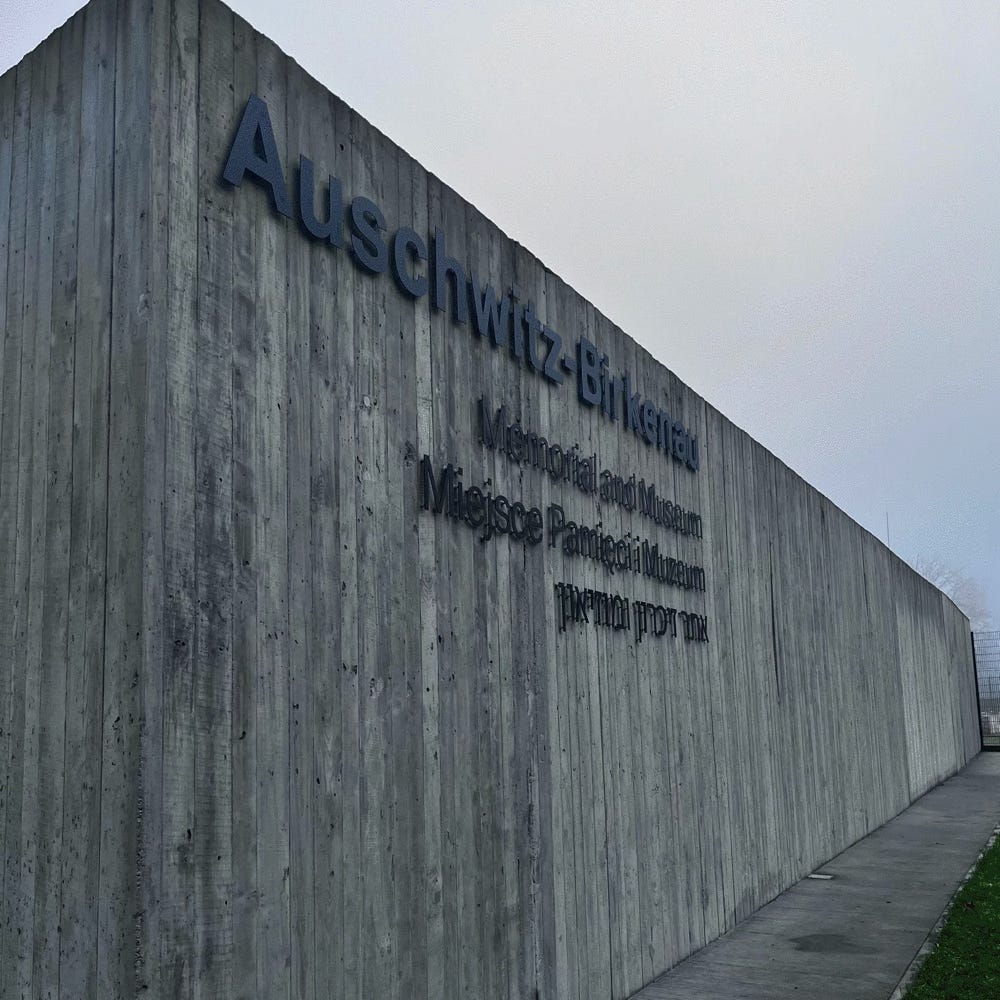
When I finally emerged from the cab into the main parking lot I realized you can’t see past the modern concrete Visitor Center to the original Auschwitz just beyond. Thinking I might narrate my visit, I recorded my first impressions on my phone:
I am here at Auschwitz-Birkenau Memorial and Museum. It is Wednesday, December 3rd at around 9:30 a.m. My tour is at 10:15 a.m. Due to circumstances beyond my control, namely the tour that I had booked through Krakow Direct was canceled on me mere weeks before our trip to Krakow, and I had to scramble to get onto any tour at all, and I ended up on a German language tour because no more English tours were available. So I will be walking around with a bunch of Germans today. Ironic and strangely apropos, but, when Sweet T. mentioned coming to Krakow initially, I said, “You know, I’ll stay home and watch the cats and then we won’t have to get a cat sitter.” Then I started looking into Krakow and just what an incredible city it is, with medieval and Romanesque and Baroque and Gothic architecture, and the largest intact town square in Europe and buildings that date back to the 1500s and I thought, okay. And then the further realization that Auschwitz is 31 miles southwest of Krakow. That clinched it for me, because I’ve long been horrified and fascinated by Nazis and their killing machine and the process of dehumanization, which is going on even today as we speak. On the train ride from Kraków Glowny Station this morning, there was a New York Times headline about Donald Trump calling Somalis “Garbage.” And of course, he’s famous for dehumanization and labeling people he doesn’t like vermin, including the press. And as I said on Facebook, I’m not saying that Donald Trump is a Nazi, but he would have made a great one. They would have been very proud to have him. Anyway, here I am, in front of the entrance, waiting. My 9:45 ticket – tickets are for 10:15 but I can walk in at 9:45 and get on line, I guess, and gather with the Germans I’m going to be touring with. But this place is mobbed. It’s a very foggy Wednesday, but the tour buses keep appearing. There are three right now trying to get in, but the parking lot is fairly full and all around there are knots of people – twenty, thirty – and they just keep coming and, from all over the world, not just from the United States, but from every country you can imagine. Auschwitz and the whole complex known as Auschwitz-Birkenau was obviously the pinnacle of the Nazi killing machine and a warning to us all of just what happens when you start dehumanizing people. So, this ought be interesting, especially because, the backup battery I brought for my phone isn’t quite working, and I’m at about 59% power, so I’m probably going to have to turn my phone off. I’m not really sure I’m going to be taking pictures in there. I feel like there’s plenty of pictures out there, and my pictures aren’t going to add a single goddamn thing to the experience, so I may just try to soak it all in. Or if anything, do some audio recording. I’m not even clear on what’s allowed inside in terms of, audio or video or photography. So I’m sure we’ll find out. And, maybe I’ll get to use some of my seventh grade German. I should have probably stuck with it and really learned how to speak it fluently. But there you go. And here we are.
I found the restaurant, which was more cafeteria, and sat sipping coffee until it was time to make my way inside the Visitor Center and find my Deutsch-speaking group. When I finally did, we quickly realized 20 out of 22 of us didn’t speak German. The Deutsch group is apparently where everyone who couldn’t make it on to an English-speaking tour ends up. Our tour guide, an older woman in a long puffer coat and pink hat, seemed beyond disappointed in the bulk of us, pointing out “I don’t speak English.” in English. Because ChatGPT had lied to me, explaining that non-existent audio guides were available “for free” in the Visitor Center, I ended up in the bookstore buying an English-language guidebook. Soon, our tour guide led us down a long path into the original Auschwitz, the Polish Army barracks the Nazis initially repurposed as a Polish POW prison. To see the infamous Arbeit Macht Frei sign (a reproduction anyway: the original –stolen in 2009 and since recovered – is still in storage) in person sent a chill down my spine. We stopped just inside the entrance for some preliminaries but were soon moving again due to the sheer number of people behind us. I don’t know what I was expecting but it began to feel like the museum’s organizers were trying to give us some feel for what it must’ve been like to be crowded into those former barracks with thousands of others. We had to keep moving, so I finally abandoned my constant consulting of the English-language guide I’d bought and removed the uncomfortable headset pumping our guide’s soft, affectless Deutsch into my ears.
When we got to a wall-sized map showing the far-flung points in Europe from which Auschwitz’s victims were shipped in conditions unfit for livestock, a deep sorrow descended. It was all there on that map: the monstrous Nazi ideology of racial cleansing and desire for lebensraum (“living room”), facilitated by the Third Reich’s mania for technology and efficiency had delivered millions to this foreboding place to meet a grim death. Our group shuffled in and out of buildings past the huge mounds of human hair (the Nazis turned it into wool used to make socks for the Navy, etc.), prosthetic limbs, luggage, prayer shawls, eyeglasses and purloined valuables. As our tour guide repeatedly mentioned “Kanada” I found myself wondering if the couple I’d met from Saskatchewan were feeling aggrieved.
We were shown the Death Wall where initial victims where shot to death and the spot where the camp’s first commandant, Rudolf Höss, was hanged. On the train ride this morning I read about Höss, the person who ushered in the use of hydrogen cyanide (produced from the pesticide Zyklon-B), turning Auschwitz into the most efficient Nazi murder machine. Then I recalled the statement Höss made before they strung him up…
My conscience compels me to make the following declaration. In the solitude of my prison cell, I have come to the bitter recognition that I have sinned gravely against humanity. As Commandant of Auschwitz, I was responsible for carrying out part of the cruel plans of the “Third Reich” for human destruction. In so doing I have inflicted terrible wounds on humanity. I caused unspeakable suffering for the Polish people in particular. I am to pay for this with my life. May the Lord God forgive one day what I have done. I ask the Polish people for forgiveness. In Polish prisons I experienced for the first time what human kindness is. Despite all that has happened I have experienced humane treatment which I could never have expected, and which has deeply shamed me. May the facts which are now coming out about the horrible crimes against humanity make the repetition of such cruel acts impossible for all time.
…and his farewell letter to his eldest son:
Keep your good heart. Become a person who lets himself be guided primarily by warmth and humanity. Learn to think and judge for yourself, responsibly. Don’t accept everything without criticism and as absolutely true... The biggest mistake of my life was that I believed everything faithfully which came from the top, and I didn’t dare to have the least bit of doubt about the truth of that which was presented to me. ... In all your undertakings, don’t just let your mind speak, but listen above all to the voice in your heart.
As we exited Auschwitz for the short shuttle bus ride to Auschwitz II-Birkenau, I found myself looking for the house Höss occupied with his wife and five children, as depicted chillingly in the excellent film The Zone of Interest. On the shuttle bus I somehow lost my English-language guide and by the time we arrived I was feeling a bit queasy to have been marinating in so much death and hatred all morning.
When the iconic Auschwitz II-Birkenau gatehouse – with those railroad tracks leading to the gas chambers running through – came into view it struck me as bizarre to see so many modern vehicles parked in front. I was further jolted by the huge roving bands of teenagers simultaneously absorbed in their phones while laughing, jostling and flirting with each other as if they were wandering through a particularly morbid open-air mall. Our tour guide – locked in deep conversation with the only two members of our group who sprechen sie Deutsch – didn’t notice when I broke away and circled back to the shuttle bus. I had seen enough.
On the Ośwęicim train platform I met three midwives from England who explained why I’d been hearing so many U.K. accents: “It’s a two hour flight and it’s CHEAP!” After we commiserated about Call The Midwife, one of the midwives loaned me her power bank so I could charge my depleted phone aboard the train. Back at Kraków Glowny station I wandered into the Galeria Krakowska mall, where I stumbled into a Media Markt location in search of a new power bank as distraction from all I’d just seen.
It didn’t work.